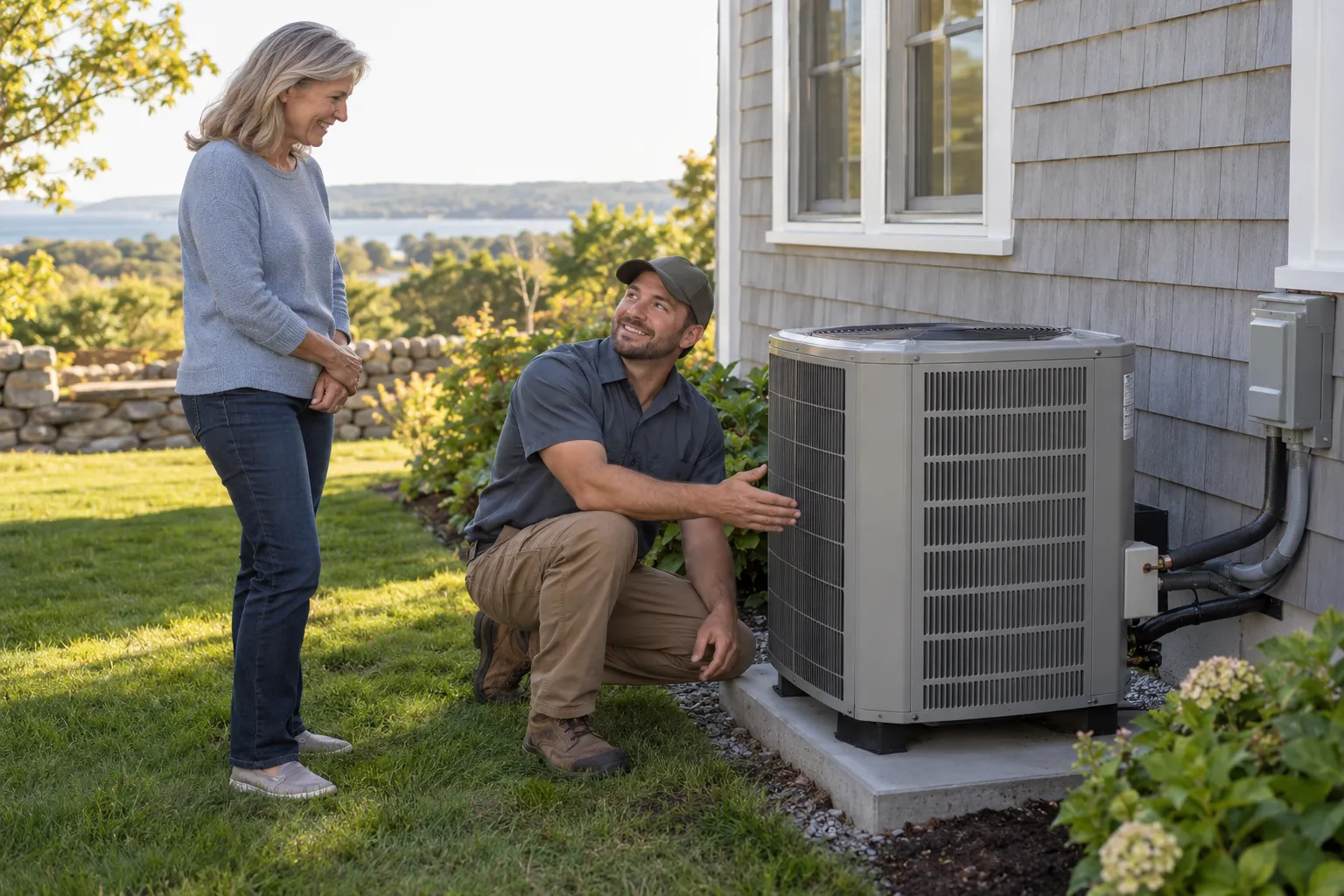
A new air conditioner is a big purchase. Most homeowners only make it once or twice. That can feel scary if you have never done it. This page walks you through it in short, plain words. You will learn the signs of a worn-out unit, the main system types, and why size matters.
Expertdesigns Heating & Air is a referral service. We do not install or repair anything ourselves. We connect homeowners in the Shelton area with independent HVAC providers in our network. A provider can look at your home, explain your choices, and give you a written quote. You can request an estimate with no obligation, and you decide what happens next.
Your AC is old, loud, or failing, and you have no idea what comes next. That is a normal place to be. This page gives you plain answers first. Then it points you to a local provider.
Small signs first: is your AC wearing out?
Most central air conditioners last about 12 to 15 years. A short cooling season can stretch that. Age is only part of the story. Watch for these signs:
- Repair bills show up every summer.
- Air from the vents feels warm or weak.
- Your power bill climbs, but your habits did not change.
- The unit rattles, squeals, or bangs.
- Some rooms stay hot while others get icy.
- Ice forms on the pipes or the outdoor unit.
- The system uses R-22. That is an older refrigerant (the fluid that carries heat out of your home). It is no longer made, so refills cost a lot.
One sign may not mean much. Two or three together usually do.
Repair or replace? A simple rule of thumb
Many providers use a quick check. Multiply the repair price by the age of the unit in years. If the answer is well above $5,000, replacing may make more sense. It is a guide, not a law. Ask the provider to show you their thinking.
If your AC dies in a heat wave, ask about emergency AC repair first. You can cool the house now and plan a replacement later with a clear head.
Plan before the heat arrives
When winters are cold and snowy, the cooling season is short. Many people forget the AC until the first hot week. Then every provider gets busy at once. Spring and fall are calmer times to ask questions and compare quotes. Waiting is fine if your unit still works. Just do not wait until it quits.
Types of cooling systems
You have a few main choices:
- Central AC. An outdoor unit and an indoor coil send cool air through ducts. Ducts are the metal tubes in your walls and ceilings.
- Heat pump. One system cools in summer and heats in winter. Newer cold-climate models work in low temperatures.
- Ductless mini-split. Small wall units connect to an outdoor unit by a thin line. No ducts needed.
Older homes, Cape Cod style homes, and multi-family buildings often have tight spaces or no ducts. A ductless system can fit where central air cannot.
Why proper sizing matters
AC size is measured in tons. This is cooling power, not weight. Bigger is not better. An oversized unit cools fast and shuts off. It leaves the air damp and wears out sooner. An undersized unit runs nonstop and still struggles.
Ask the provider to run a load calculation. That is a math check of how much heat your home gains. Insulation, windows, a full basement, and sloped upstairs ceilings all change the answer. Do not accept a plan that just copies the old unit's size.
What an installation includes
A full job usually covers these steps:
- Removing the old unit and recovering its refrigerant safely
- Setting the new outdoor unit on a level pad
- Connecting the indoor coil, the line set (copper pipes), and the drain
- Wiring and a thermostat
- Checking ducts for leaks
- Testing airflow and refrigerant level at start-up
- Pulling a permit where your town requires one
Ask for these items in writing so nothing gets left out.
Matching the system
The indoor coil, outdoor unit, and blower should work as a set. Mixed or mismatched parts waste energy and can fail early. Tell the provider about your whole heating and cooling setup. If your furnace is also old, you may have searched for furnace replacement near me. Mention it. The provider can plan around both and may save you a second visit.
Efficiency in plain terms
SEER2 is a score for how much cooling you get per unit of power. A higher number means lower power use. Very high scores cost more up front. With a short cooling season, they can take many years to pay back. A middle score often fits a cold-weather home well. Also ask if your utility offers rebates for new systems.
Questions to ask the provider
- Will you do a load calculation, or just match the old size?
- What brand and model do you suggest, and why?
- What does the quote include? Are permits and removal in it?
- What warranty comes with the equipment and the labor?
- How long will the job take?
- Is my ductwork in good shape?
A good provider answers in plain words. If you feel rushed, get a second quote.
Take the next step
You do not need to know model numbers. You only need to say what is wrong. Request a callback to check provider availability in your area. Or send a request and compare written quotes at your own pace.
What's Included
Site Visit
A provider looks at your home, your old unit, and your ducts before suggesting a new system.
Sizing Check
The provider runs the numbers so the new unit fits your home, not just the old one.
Full Installation
Old unit out, new unit set, lines and wiring connected, and the system tested.
Written Quote
You get the price, the parts, and the work on paper before you agree.
What a New AC Costs
Prices vary a lot by home, system type, and region. These are typical U.S. ranges only. Always get a written quote from the provider before you say yes.
| Item | Typical range | Notes |
|---|---|---|
| Central AC replacement | $5,000 – $12,000 | Depends on size, brand, and efficiency |
| Heat pump installation | $5,500 – $13,000 | Cools and heats; cold-climate models cost more |
| Ductless single-zone system | $3,000 – $7,000 | Good for homes without ducts |
| Ductless multi-zone system | $6,000 – $18,000 | Price rises with each indoor unit |
| Ductwork repair or changes | $500 – $3,500 | Needed if ducts leak or are too small |
| Thermostat upgrade | $150 – $600 | Smart models cost more |
How It Works
Describe the problem
Tell us what your AC is doing and how old it is. Short notes are fine.
Connect with a provider
Request a callback or send the form. We pass your request to a local provider.
Review the written quote
The provider visits, checks the size, and gives you a quote. Ask every question you have.
Choose and schedule
Pick the provider and plan you like. The provider does the install, not Expertdesigns Heating & Air.
Why Call Expertdesigns Heating & Air
Plain answers before providers
You learn the basics first, so you can talk with a provider without feeling lost.
Local providers
We connect you with independent HVAC providers that serve your part of the Shelton area.
No obligation
Requesting an estimate does not lock you in. You choose whether to move ahead.
Calm process
No pressure and no jargon. You set the pace from first question to final choice.
Other Services

Need ac installation and replacement in Shelton?
Tell us what your system is doing. Send a short request to contact@expertdesigns.property and ask for an estimate from a local provider. There is no obligation.
No obligationAC Installation and Replacement FAQ
How do I know if I need a new AC or just a repair?
Look at age, repair history, and the cost of the fix. If the unit is over 12 years old and breaks often, replacing may make sense.
How long does an AC installation take?
Many installs take one day, and some take two. Ductwork changes or a ductless system with several indoor units can add time. The provider can give you a clear estimate of the schedule.
Does homeowners insurance pay for a new air conditioner?
Usually not for normal wear and age. Some policies may cover sudden damage, such as a storm or fire. Check your policy and ask the provider to help document damage.
Request a callback
Tell us what your system is doing. Send a short request to contact@expertdesigns.property and ask for an estimate from a local provider. There is no obligation.
No obligation